Most transformation programs fail at the same point.
Not because the framework was wrong. Not because the technology underdelivered. Because the investment landed one layer above where the problem actually lives.
Strategy, decisions, and execution were misaligned before the program started. The framework, the platform, and the initiative made that misalignment move faster.
Most organizations have experienced this. The Agile rollout that produced faster delivery but no better outcomes. The AI investment that generated dashboards no one acted on. The transformation program that ended, leaving the underlying system unchanged.
The pattern is consistent. The diagnosis is almost always wrong.
Organizations don't invest in the wrong things because they lack ambition. They invest in the wrong layer because the real problem is harder to name.
The Framework Illusion. The Technology Illusion. The Transformation Illusion.
Three distinct beliefs. The same underlying failure. Organizations invest in the right tools at the wrong layer — and then misdiagnose the result when the returns disappoint.
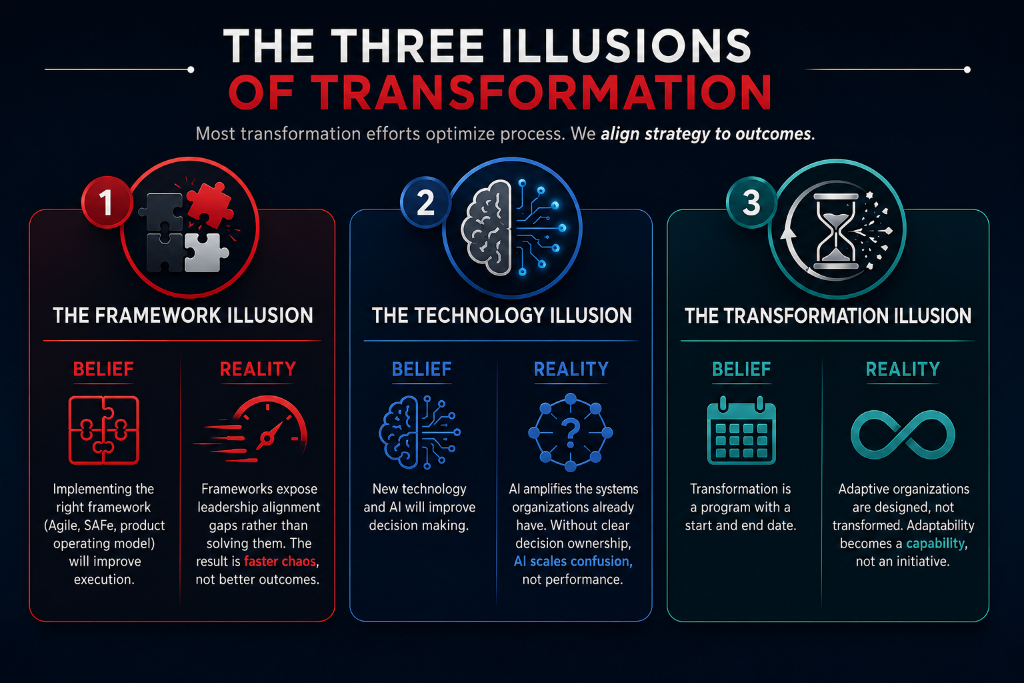
These aren't critiques of Agile, AI, or transformation programs. They are an observation about where organizations repeatedly invest — and why the returns consistently disappoint. The organizations that break the pattern don't abandon the tools. They fix the decision architecture underneath them first.
Align strategy. Improve decisions. Deliver outcomes.
Most operating models describe how work flows. InsightOS describes how organizations make decisions — and how those decisions connect to outcomes.
The five layers are not a maturity model. There is no finish line. They are the system that determines whether strategy reaches execution, whether AI amplifies good judgment or bad, and whether the organization gets sharper over time or just busier.
The question InsightOS asks at every layer is the same: is this connected to an outcome that actually matters?
Most transformation programs invest heavily in operational systems and technology — layers three and four — without establishing the strategic intent and decision architecture that give those investments direction. The result is capability without alignment. Activity without outcomes.
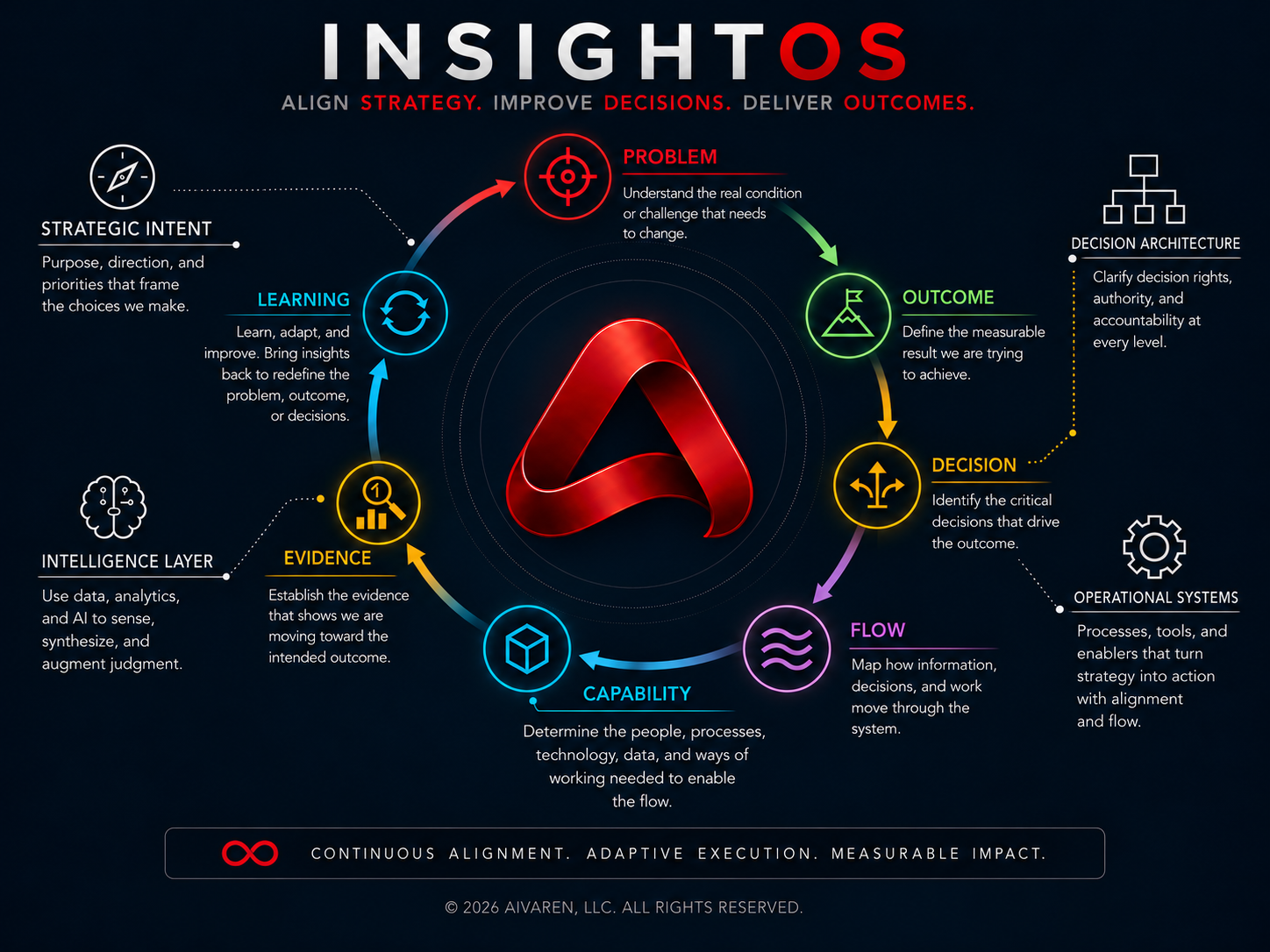
The five layers are the anatomy. The reasoning loop is the physiology.
Knowing the layers tells you what's supposed to be aligned. It doesn't tell you how an organization actually reasons its way from a problem to a decision it can defend. That's a separate question — and it's where most diagnostics stop short.
InsightOS answers it with a seven-stage loop that runs underneath the five layers: Problem → Outcome → Decision → Flow → Capability → Evidence → Learning. Each stage is a checkpoint. A problem that never names its outcome. A decision that never reaches the people doing the work. Evidence that gets collected but never closes the loop back to learning. The loop doesn't replace the five layers — it's what determines whether they're actually functioning, or just present.
Agile didn't introduce fragility into the system. It just exposed it. The same is true of AI, and of every framework before it. The loop is how you find out which one you're dealing with.
InsightOS is the diagnostic lens AIVAREN uses to find where the misalignment lives — and what needs to change first.
"AI belongs in the Intelligence Layer. It amplifies the systems organizations already have. If those systems are misaligned, AI scales the problem."